Custom software for higher education

Custom software
for higher education
and mission-driven work.

REDTech Solutions designs and builds custom web applications, data platforms, and cloud infrastructure for higher education and mission-driven organizations — built around how you actually work, not how a vendor imagines you do.

A note on process — We work in weeks, not quarters. You see working software inside the first month, and your team ships production workflows inside the first three.
I.Web applications
II.Cloud infrastructure
III.Data & analytics
IV.AI integration
V.Automation
VI.Consulting
Platforms running at
Southeastern University / LiFT Institute / SEU Network Partners / Mission-driven orgs nationwide

Three years of real, shipped work — no pitch decks, no vaporware.

Every number below represents software in production today, serving institutions that depend on it. The platforms run on infrastructure we built, deployed from pipelines we own, monitored by dashboards we read every morning.

Platforms live
5+
Production systems, each serving a distinct institutional need.
Years in production
3+
The platforms shipped in 2023 are still the ones in active use today.
Programs analyzed
269
Academic programs tracked across 62 peer institutions in the Portfolio Engine.
Off-the-shelf
0%
Everything custom. If it doesn't fit your workflow, we don't ship it.
Capabilities

What we build.

Strategy, design, engineering, and infrastructure as a single continuous loop. Every platform ships with CI/CD, monitoring, and documentation.

I · Web Applications

Full-stack apps, shipped in weeks.

Custom React + TypeScript applications on Google Cloud Run with Workload Identity Federation. Discovery to production without the usual six-month slog.

React 19TypeScriptNode.jsPrismaTailwind
II · Cloud Infrastructure

GCP done right.

Cloud Run, BigQuery, IAM, Secret Manager, and CI/CD pipelines with Workload Identity Federation. Staging-to-production promotion on every merge.

Cloud RunBigQueryWIFGitHub Actions
III · Data & Analytics

Dashboards people actually use.

Interactive dashboards, data pipelines, and decision-support tools. SQL Server integration, BLS & IPEDS datasets, real-time analytics your team can trust.

RechartsD3BLSIPEDSPostgreSQL
IV · AI Integration

LLM features that do real work.

Gemini-powered credentialing, natural-language program analysis, AI-augmented workflows. Not chatbots — systems that replace hours of manual review.

GeminiRAGEval loopsStructured outputs
V · Workflow Automation

The manual work disappears.

Google Apps Script bridges, automated reporting, LOI pipelines, credential engines. If your team is copy-pasting between systems, we can probably kill that.

Apps ScriptWorkflowsSheets APICloud Functions
VI · Consulting

Senior partnership, not a deck.

Architecture review, vendor evaluation, digital transformation roadmaps, accreditation support. Thinking with you — not selling at you.

ArchitectureRoadmapsVendor evalAccreditation
Portfolio

Selected work.

Five platforms, live in production today — each built around real operational needs, not a product roadmap invented by a vendor.

Case 01 / Faculty credentialing / LIVE

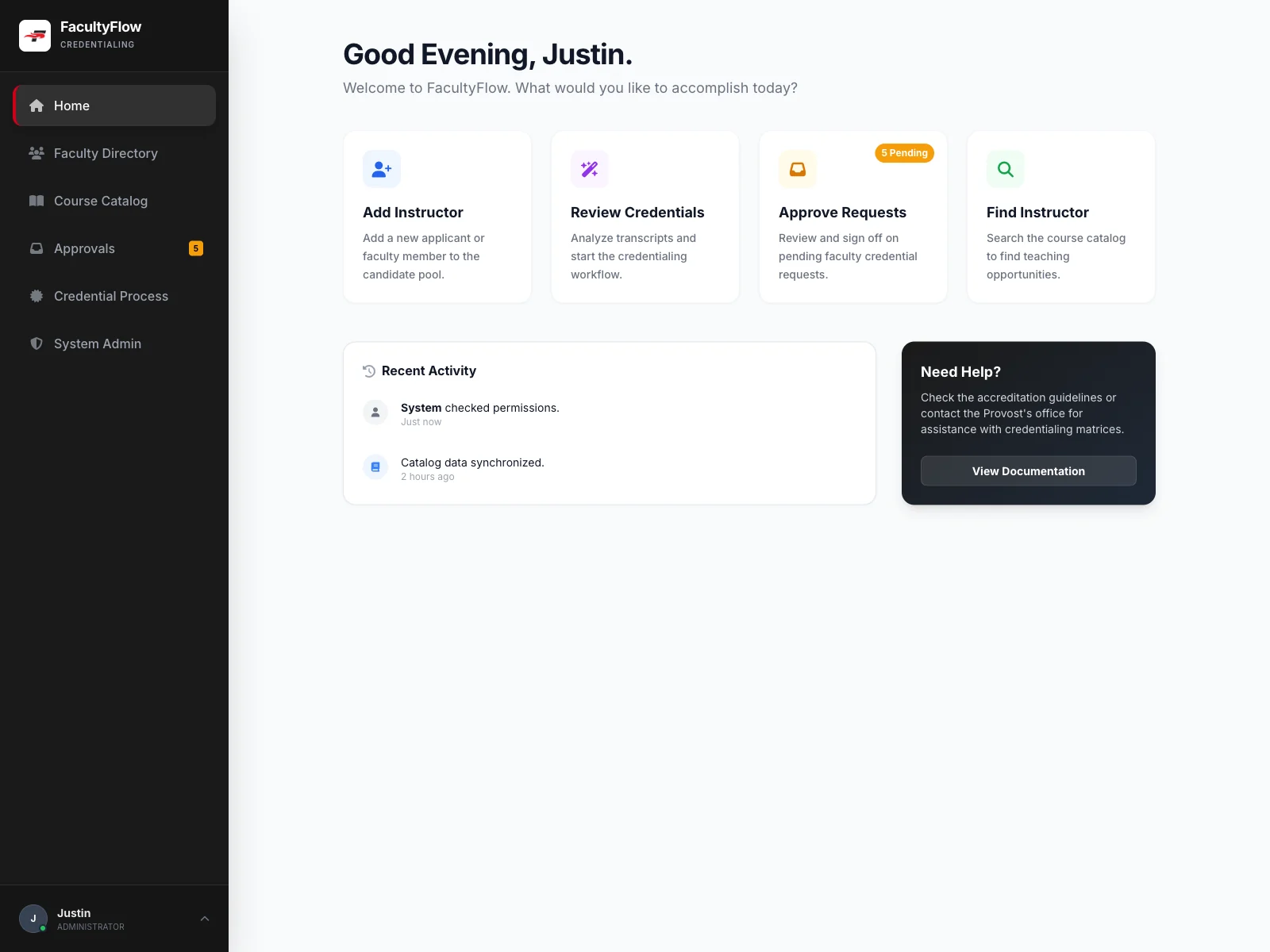
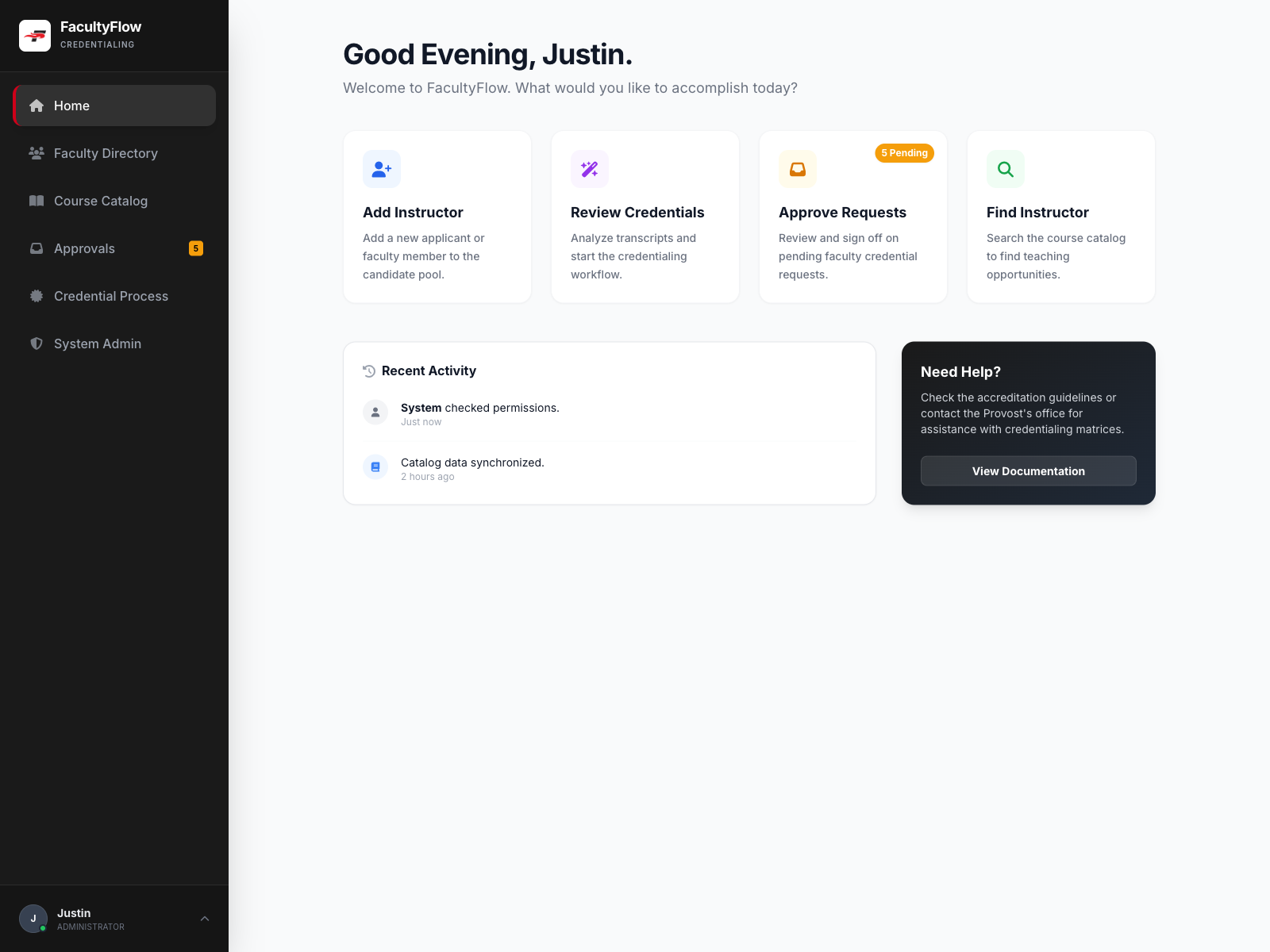
Faculty Flow. — weeks of review, compressed to seconds.

An AI-powered credentialing engine that automates credential analysis, qualification mapping, and compliance reporting. Replaced weeks of manual review with instant, auditable results — and a paper trail accreditors actually like.

98%time saved
400+faculty
5savg. analysis
ReactTypeScriptCloud RunGemini AISheets API
facultyflow.app
Faculty Flow credentialing dashboard
shipped — 2024
Case 02 / Strategic assessment / LIVE

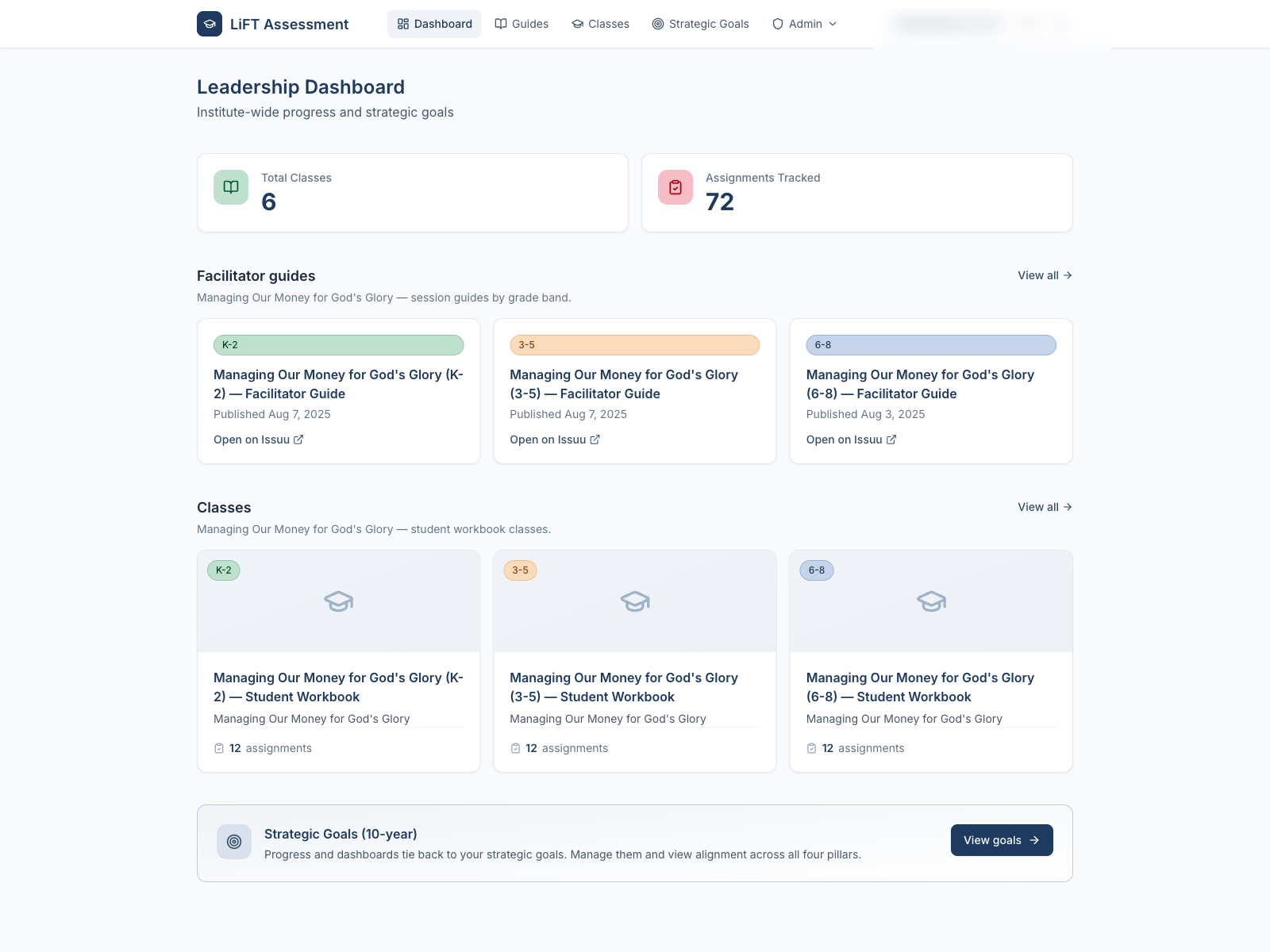
LiFT Assessment. — a 10-year plan, visible every Monday morning.

Progress tracking across K–Adult educational bands aligned with 10-year strategic goals. Multi-stakeholder dashboards with real-time visualization and institutional impact metrics — leadership finally sees the system as a system.

10yrhorizon
K–Adultbands
Real-timereporting
ReactPrismaCloud RunPostgreSQLOAuth
lift.assessment
LiFT Assessment Portal dashboard
shipped — 2025
Case 03 / Program analytics / LIVE

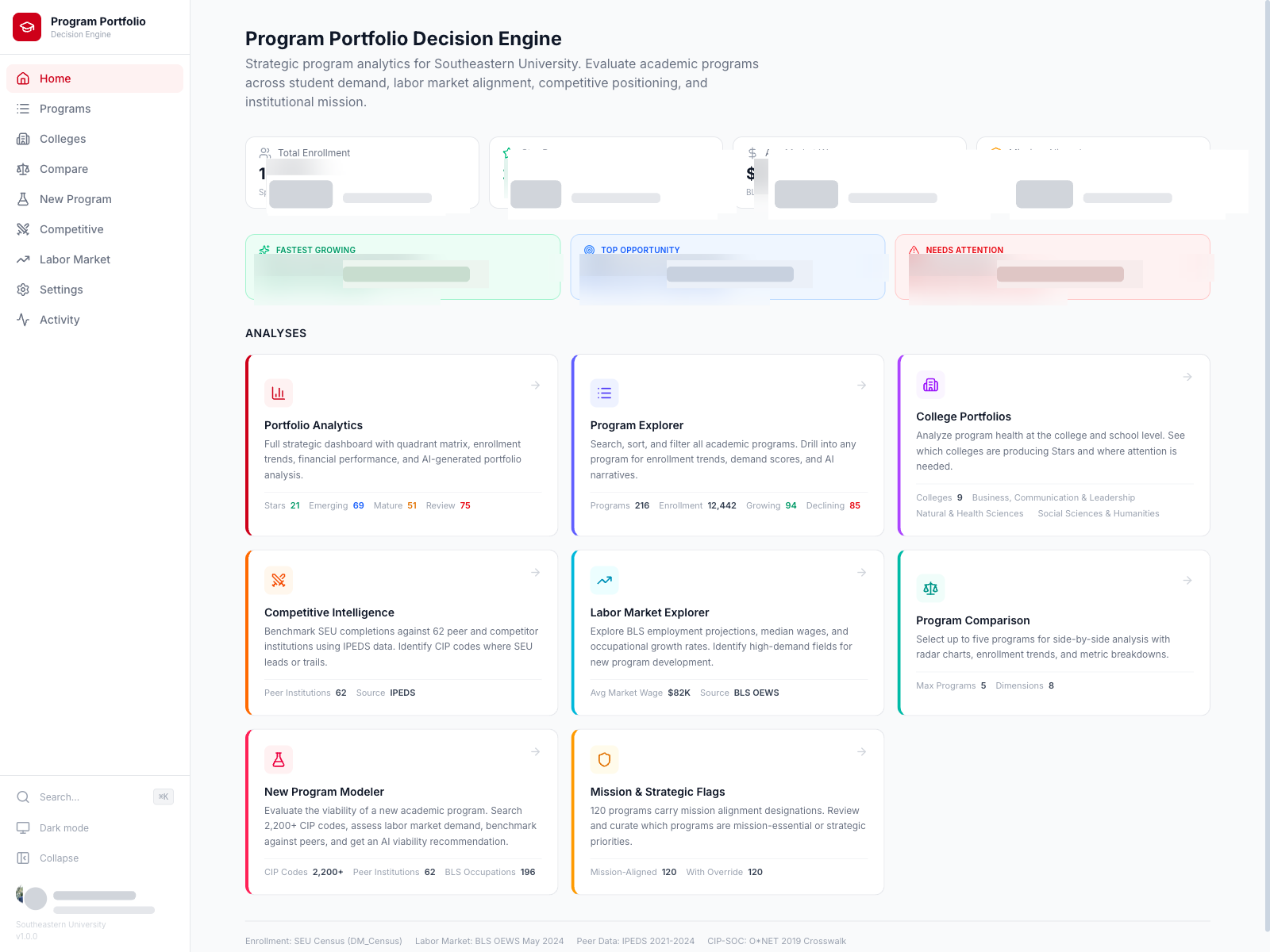
Portfolio Engine. — 269 programs, one decision surface.

A decision-support platform analyzing academic programs against DFW rates, labor market demand, peer benchmarking, and competitive landscape intelligence across 62 institutions. Program review decisions that used to take months now take a meeting.

269programs
62peer inst.
BLS+IPEDSsources
ReactExpressRechartsBLS/IPEDSGemini AI
portfolio-engine
Program Portfolio Decision Engine
shipped — 2025
Case 04 / Partner CRM / LIVE

Network Partner Hub. — relationships, not rows in a spreadsheet.

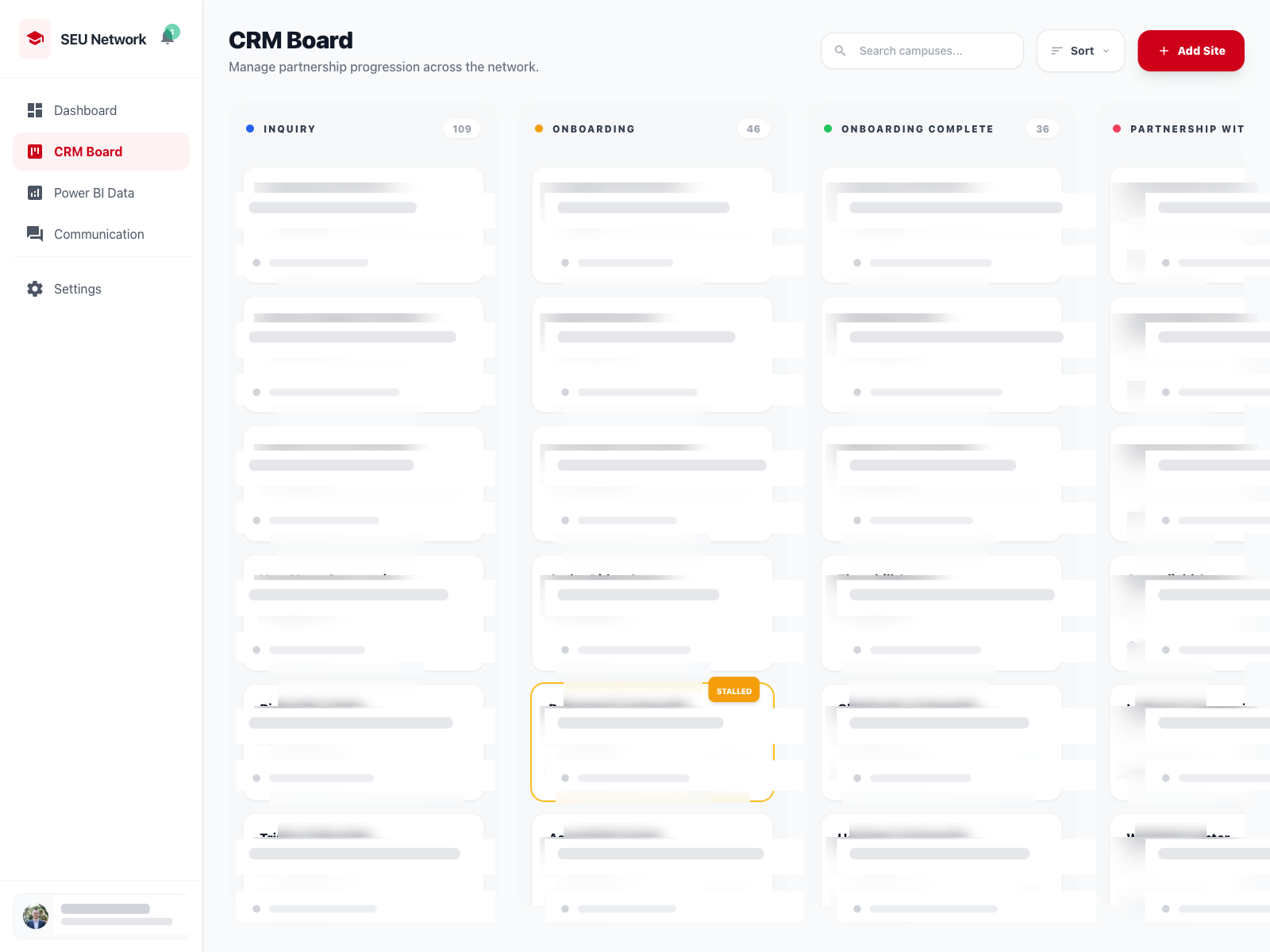
Relationship management for a national network of partner sites. Tracks site agreements, faculty assignments, student placements, and automates Letter of Intent workflows end-to-end — from first contact through fully-executed agreement.

40+partner sites
AutoLOI flow
Real-timesync
React 19TypeScriptCloud RunApps Script
network-crm
Network Partner Hub CRM
shipped — 2026
Case 05 / Student feedback analytics / LIVE

Course Evaluations. — eight years of anonymous student feedback, finally legible.

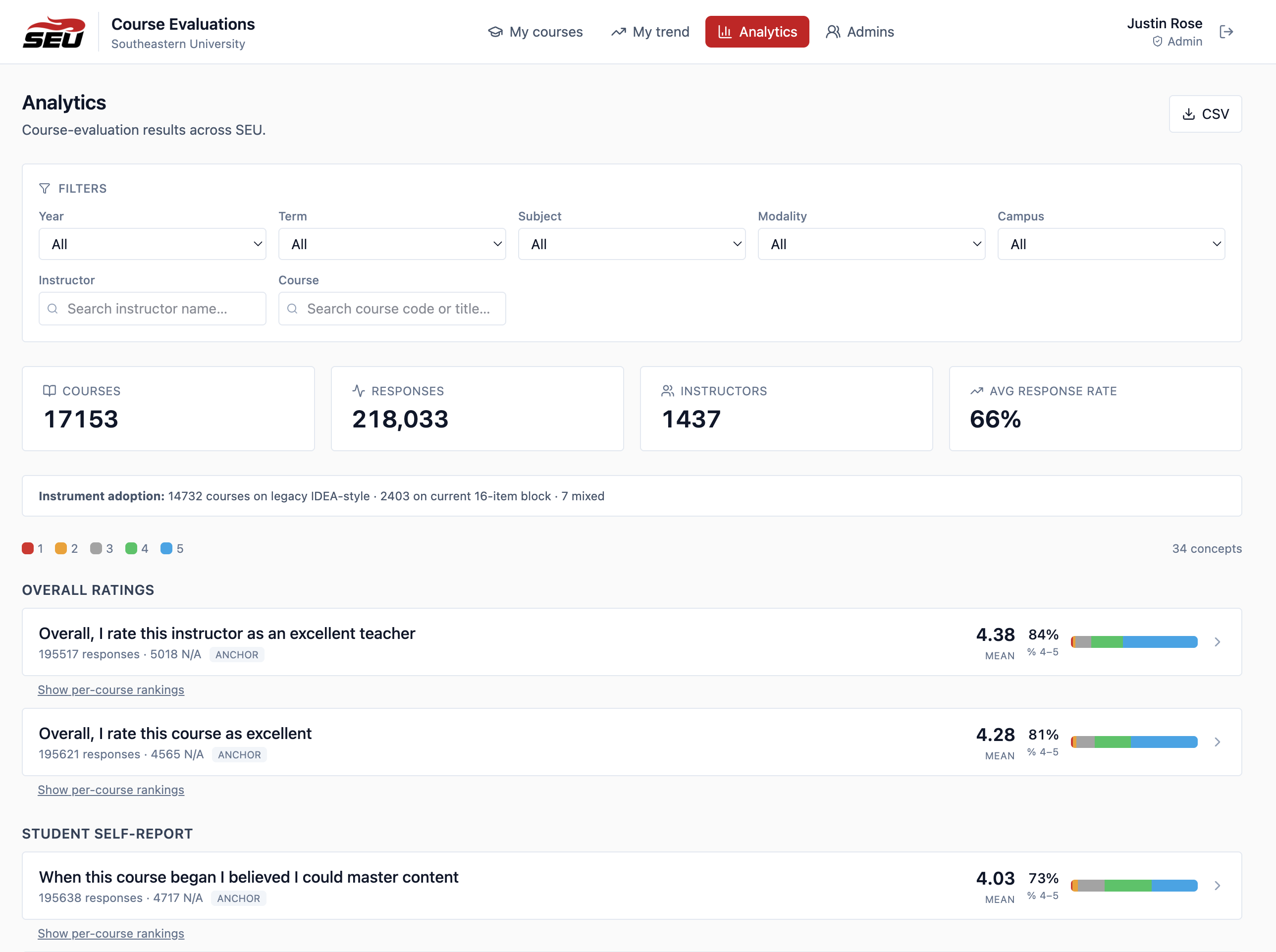
Faculty self-service plus institutional analytics over every course evaluation in MyFire since 2018. Two instruments — legacy IDEA-style and the current 16-item teaching-practice block — harmonized into one stable concept layer so career trends survive the instrument transition. Per-course PDF reports, bulk export across an entire teaching career, anonymity-preserving thresholds baked in.

218Kresponses
17Kcourses
1.4Kfaculty
React 19TypeScriptExpressSQLiteCloud RunPDFKit
course-eval
SEU Course Evaluation analytics dashboard
shipped — 2026
“I don't just build software for institutions. I use it every day. That dual perspective — builder and end-user — is the whole point.”
J
Justin Rose Founder · VP Digital Strategy, SEU
Method

How we work.

Four phases. Weeks, not months. Working software inside the first month — not wireframes and promises.

01. Discovery Week 1

Map the workflows, the constraints, and the goals — before anyone touches a keyboard.

We sit with your team, walk through real workflows, and ask the uncomfortable questions early. No assumptions. No pitch deck. Just listening, documenting, and turning institutional knowledge into something actionable.

Delivers Workflow map Success criteria Constraints memo
02. Architecture Weeks 2–3

Data models, integrations, user flows, infrastructure — planned upfront, validated with you.

We plan before we build. Schemas, auth flows, infrastructure diagrams, integration points — all reviewed with your team before a line of code ships. This is where six-month rewrites get prevented.

Delivers Data model Infra plan Review doc
03. Build Weeks 3–8

Rapid development with continuous feedback — working software, early and often.

Shipping to staging from day one. Your team sees real screens in real browsers by week three. Feedback loops are measured in days — not in "next sprint, we'll circle back." You stay in the loop; we stay in the code.

Delivers Staging builds Weekly reviews CI/CD pipeline
04. Launch & Support Ongoing

Production deployment with CI/CD, monitoring, and documentation — and someone who answers the phone.

Launching is the middle, not the end. Monitoring, alerts, on-call, scheduled maintenance, and documentation your team can actually read. The platforms we've shipped are still the ones we maintain — that's the model.

Delivers Monitoring Runbooks Maintenance SLA
Engagement

How we take on work.

Three ways in — discovery, build, or ongoing. Fixed-scope proposals, no seat licenses, no surprise invoices.

A 1–2 weeks

Discovery Sprint

A short, fixed-fee engagement to map workflows, interview stakeholders, and draft the architecture memo. The best way in if the scope isn't settled yet.

  • Stakeholder interviews
  • Workflow & constraint map
  • Architecture memo
  • Scoped build proposal
Fixed fee · Credited against build
C Monthly

Ongoing Partnership

Retainer for monitoring, maintenance, and continuous improvement. The platforms we shipped in 2023 are still on this plan — we don't hand off and vanish.

  • Monitoring & uptime
  • Scheduled maintenance
  • Priority feature work
  • On-call escalation
Retainer · Sized to platform
Principles

What we do — and don't.

A small shop with a short list. The clarity is the point.

We do ✓ Yes

  • 01Build custom platforms around real workflows — not templates, not themes.
  • 02Ship software in weeks, then maintain it for years.
  • 03Sit with your team — faculty, staff, leadership — before architecture is written.
  • 04Write documentation humans can read. Monitoring humans can trust.
  • 05Own the stack we ship — Cloud Run, BigQuery, Postgres, React.
  • 06Partner long-term. The platforms we built in 2023 are still the ones we run.

We don't ✗ No

  • 01Sell SaaS licenses that expire the day you need a new feature.
  • 02Write 80-page decks before showing working software.
  • 03Pretend a one-size-fits-all vendor platform will fit your institution.
  • 04Hand off to an offshore team the day the statement of work clears.
  • 05Charge for roadmaps we never planned to build.
  • 06Take on work we can't ship with the quality our name's on.
The team

The studio.

One operator, a deliberate scope — and real skin in the game.

Founder / Lead Engineer 2023 →
JR
Justin Rose Lakeland, FL
—j.

Built by someone who understands your world — because he lives in it.

REDTech Solutions is led by Justin Rose — a technologist who has spent his entire career inside higher education. As Vice Provost of Digital Strategy at Southeastern University, he doesn't just build software for institutions: he uses it, maintains it, and depends on it every day.

That dual perspective — builder and end-user — means every platform we create is designed around how institutions actually work, not how a vendor imagines they do. The result: systems that stick, teams that trust them, and outcomes you can measure.

10+ yrsIn Higher Ed IT
SEUVP Digital Strategy
Google CloudPlatform of record

“The goal isn't to ship software. The goal is to ship outcomes — the software is just the vehicle.”

FAQ

Questions we get on every call.

Short answers to the ones that always come up before a scope lands.

01 How do engagements typically start?
A 30-minute intro call, followed by a short Discovery Sprint to map workflows and draft the architecture memo. Nothing gets built until the scope is clear and the success criteria are on paper.
02 Who owns the code and the infrastructure?
You do. Code lives in your GitHub organization; infrastructure deploys to your Google Cloud project; domains and data are yours. There are no REDTech licenses, no shared tenancy, and nothing held hostage.
03 Do you work with our internal team?
Usually, yes. Most engagements pair with an internal developer, IT staff, or data team. The goal is to leave your organization better equipped to maintain the platform — not dependent on us forever.
04 What about privacy, security, and FERPA?
Platforms are designed for higher-ed and regulated environments from day one: SSO through your identity provider, least-privilege IAM, audit logging, and data residency in your cloud. FERPA and compliance specifics are scoped explicitly in the architecture memo.
05 How is pricing structured?
Discovery sprints are fixed-fee and credited against the build. Platform builds are project-based with fixed scope and fixed price. Ongoing partnerships are a monthly retainer sized to the platform. No hourly billing, no seat licenses, no per-user uplift.
06 What happens after launch?
The platforms we ship are the ones we run. Most clients stay on an ongoing partnership for monitoring, feature work, and the occasional late-night incident — the ones that don't still get 30 days of launch warranty and full documentation on the way out.

Still have a question? Drop a note and you'll hear back the same day.

Book a 30-min call